

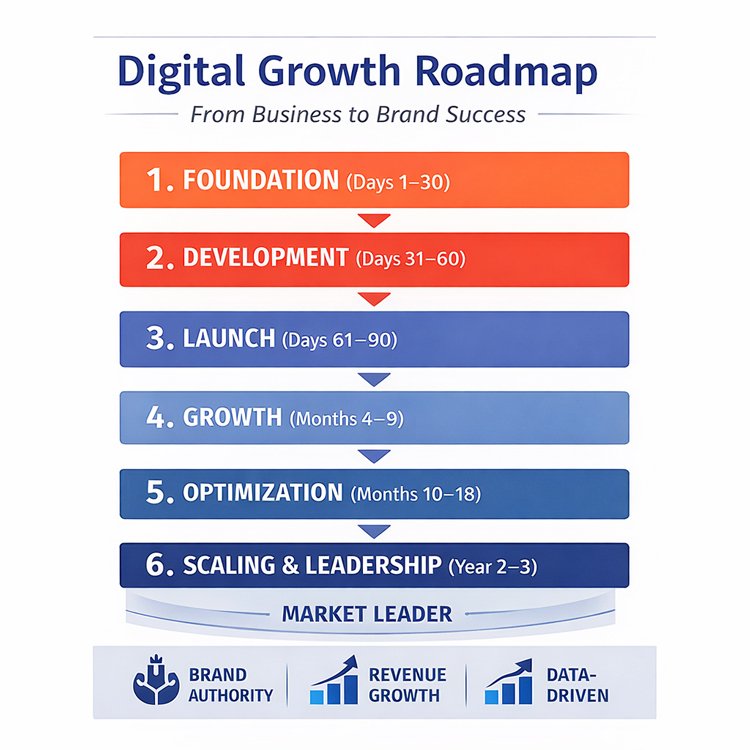
Introduction: Why “Just Being Online” Is No Longer Enough
Today, every business has a website, runs ads, or posts on social media.
But only a few succeed in building real brand value, predictable revenue, and long-term market leadership.
The difference lies in strategy, structure, and ownership.
At eOneStop Solutions, we believe businesses should not depend entirely on fragmented agencies or short-term tactics. Instead, they should build a lean in-house digital ecosystem that works like an internal digital partner, aligned deeply with business goals.
This blog explains a complete, stage-wise roadmap to transform a business into a brand using a web portal + full digital marketing ecosystem.
The Core Philosophy: Business → Brand → Market Leader
A successful digital journey follows this cycle:
Clarity → Platform → Traffic → Leads → Revenue → Data → Optimization → Authority
This roadmap is designed to:
-
Build trust before selling
-
Capture demand at every funnel stage
-
Use data to continuously improve decisions
-
Create compounding growth (not short-term spikes)
Phase 1: Foundation – Strategy Before Screens (Days 1–30)
Business Objectives
-
Define clear brand positioning and value proposition
-
Identify ideal customer profiles (ICP)
-
Finalize revenue and growth model
-
Decide the right tech and marketing stack
Key Deliverables
-
Brand positioning & messaging framework
-
Customer journey mapping
-
Web portal architecture blueprint
-
Martech stack (CMS, CRM, Analytics, Ads, Automation)
-
KPI & reporting framework
Success Metrics
-
Clear ICP and business goals defined
-
Ownership clarity across teams
-
Approved tech and data architecture
Risks if Ignored
-
Confused brand identity
-
Wrong platform decisions
-
Marketing without direction
Phase 2: Development – Building the Digital Asset (Days 31–60)
Business Objectives
-
Develop a scalable, SEO-ready, conversion-focused web portal
-
Ensure the platform supports marketing, sales, and analytics
Key Deliverables
-
UX-first, mobile-optimized portal
-
CMS with modular features
-
Lead capture & CRM integration
-
Technical SEO foundation
-
Analytics & tracking setup
Success Metrics
-
Core Web Vitals pass
-
Clean site architecture
-
Accurate GA4 & Tag Manager data
Risks
-
Designing without SEO
-
Ignoring speed and performance
-
Weak tracking implementation

Phase 3: Launch – Visibility with Purpose (Days 61–90)
Business Objectives
-
Go live with a strong brand narrative
-
Start generating qualified leads
-
Validate messaging and funnels
Key Deliverables
-
Website launch
-
Initial SEO content live
-
PPC campaigns activated
-
Lead funnels & CRM workflows
Success Metrics
-
First organic impressions
-
Cost per lead benchmarks
-
Engagement & conversion rates
Phase 4: Growth – Demand & Revenue Expansion (Months 4–9)
Objectives
-
Increase traffic, leads, and revenue
-
Strengthen brand recall and authority
Key Actions
-
Content cluster expansion
-
Funnel-based PPC optimization
-
Social media trust-building
-
CRM-driven follow-ups
KPIs
-
Organic traffic growth (MoM)
-
Lead-to-sale conversion rate
-
Customer acquisition cost (CAC)
Phase 5: Optimization – Profitability & Efficiency (Months 10–18)
Objectives
-
Reduce waste, improve ROI
-
Use data to refine strategy
Key Actions
-
Conversion rate optimization (CRO)
-
Attribution modeling
-
Budget reallocation based on performance
Phase 6: Scaling – Becoming a Market Leader (Year 2–3)
Objectives
-
Own your category digitally
-
Build thought leadership and community
Key Actions
-
Founder-led content & PR
-
Community platforms
-
Automation & AI-driven insights

Connected Functional Strategies (How Teams Work Together)
SEO Team
-
Keyword intent mapping (TOFU, MOFU, BOFU)
-
Content clusters & pillar pages
-
Technical SEO & link building
-
Long-term organic demand creation
Social Media Team
-
Brand storytelling & positioning
-
Educational and trust-driven content
-
Community engagement & social proof
PPC Team
-
Funnel-based campaigns
-
Budget allocation by intent
-
Continuous ROI optimization
Lead Generation Team
-
High-converting landing pages
-
Smart forms & automation
-
Lead nurturing workflows
CRM & Lead Management
-
Lead scoring
-
Pipeline stages
-
Sales & marketing alignment
Data Analytics Team
-
GA4 dashboards
-
Attribution models
-
Performance insights & reporting
100-Day Execution Plan (High-Level Overview)
Days 1–30
-
Planning, positioning, design, architecture
Days 31–60
-
Development, integrations, SEO setup
Days 61–100
-
Launch, campaigns, lead generation, data collection
Post 100 Days (Continuous)
-
SEO, SMM, PPC optimization
-
Offers, discounts, retargeting
-
Data analysis & strategy realignment
Why This Model Works Better Than Traditional Agencies
✔ Full ownership
✔ Aligned with business goals
✔ Data-driven decisions
✔ Lower long-term cost
✔ Strong brand equity
This is not about “running ads” or “posting content”.
This is about building a digital asset that compounds growth.
Final Thoughts
A web portal combined with a well-integrated digital marketing ecosystem is not an expense—it is a long-term business investment.
At eOneStop Solutions, we help businesses design, build, and scale this ecosystem as an internal digital growth partner, ensuring every activity contributes to brand value, revenue, and market leadership.